
Funders are being asked to back long-term systems change through short-term, risk-averse grantmaking. We need to address that disconnect.
That was an essential takeaway for us from last month’s New Economies Gathering, in Bonn, an annual global event hosted by the European funder collaborative Partners for a New Economy (P4NE). This year’s theme, Turning Together, put togetherness at the heart of building fairer, more resilient and regenerative economies. It brought together funders, researchers, activists and public officials.
For us at the Trust, Accountability and Inclusion Collaborative (TAI), working where participatory governance meets climate, democracy and the economy, we listened for what might have global resonance (or provoke challenges from other regions) and the following stood out. Economic failure is feeding authoritarianism: Activist Kumi Naidoo, economist Isabella Weber and Eric Beinhocker of Oxford’s Institute for New Economic Thinking all made the same link. When economies fail to deliver affordable energy, housing and food, the far right fills the gap by offering scapegoats instead of solutions. Building an economy that meets basic needs is therefore part of defending democracy, and affordability is a problem with concrete solutions available now.
Concentrated wealth is a governance problem: Fernanda Balata, a visiting fellow at the United Nations Research Institute for Social Development, argued that extreme wealth translates into power over artificial intelligence (AI), climate finance, debt and policy, and that company law, tax rules and investment treaties help produce it. Her early framework asks how we can see, limit and direct this power, and ultimately democratize the decisions behind it. The research aims to help movements identify which wall they face (law, politics, ownership or market rules) so lessons can travel between fights. Seeing who owns and controls what is a transparency question: without beneficial ownership data, concentrated power stays invisible. The African-led UN tax convention, due to be finalized next year, is a rare opening to try to hold that power to account across borders.
We need an economic paradigm shift: Eric Beinhocker described the four economic paradigms of the 20th century, each ending in crisis. He argued that efforts that target a single layer, such as moving beyond gross domestic product (GDP), bounce off. His answer is to replace the whole stack with an economics built around human flourishing within planetary limits, where cooperation, trust and democratic shaping of power are the foundations. He calls this Market Humanism. A question from the floor named what was missing: an analysis of power and of who drives change.
The energy transition has its own extractive risks: The scramble for critical minerals is driven by great power competition, and mining is among the deadliest sectors for environmental defenders. Speakers from Global Witness and i3T called for fair global sharing of resources, lower demand through public leadership such as mass transit, and public stockpiles that buy only minerals produced to the highest human rights standards. Free, prior and informed consent for Indigenous communities, and transparency about where minerals come from, are the governance tests the transition has to pass.
Who is in the room matters: Around 88% of the world’s people live in the Global South, yet roughly four in five people on the published delegate list were based in Europe. This reflects in part P4NE’s European focus for its grantmaking, but Naidoo’s challenge was to ask who defines the problems and whose knowledge counts as expertise.
Narrative is as important as policy: The movement too often talks to itself. Speakers urged plain language, a positive vision of sufficiency and affordability that people already want, and investment in culture. Naidoo’s test was whether you could explain your work to your family in two minutes. He also urged us to build on the 90% that unites us rather than the 10% that divides.
Law and governance can change who gets a voice: The More Than Human Legal Lab, run by Lawyers for Nature, used a case study based on the Whanganui River in Aotearoa New Zealand, which has legal personhood. Its guardianship body is co-appointed by the river’s iwi and the Crown, and a long-term strategy group brings together iwi, local government and other interests. The example leads us to a question at the heart of participatory governance: who speaks for whom, with what authority, and who enforces the outcome?
What does this mean for funders?
P4NE acknowledged that funders’ growing recognition of the need for systemic change does not yet translate quickly into funding. The conversations with funders were candid about how hard it is to put these ideas into practice. Recommendations included:
Fund the long game. New economy and climate work is a 15- to 20-year project, yet two- to three-year grants remain common. Some funders are moving to five-year grants or repeated renewals. Patient support for infrastructure, networks and storytelling matters more than projects that photograph well in annual reports.
Prepare collectively for the next crisis. Pre-position resources, so the next shock opens a new path rather than a return to business as usual.
Lighten the load on partners. A common funding application would cut transaction costs, and funders could adopt a “culture of emergence”: agree on the direction and invite partners to co-create the details.
Shift decisions closer to communities. Participatory grantmaking, such as funding community renewables, and backing alternatives that communities are already leading came up repeatedly.
Resource leadership from the Global South. Naidoo proposed a Global Commission for a New Economy that reflects how the world looks, and urged regional convenings, virtual if needed. Funders can also back new economy infrastructure led from the Global South, such as a hosted initiative being set up in Singapore to build a shared strategy for Asia.
Protect partners without losing accountability. Rising hostility toward civil society is pushing funders toward discretion: quieter funding routes, minimal documentation and lower public profiles. For those of us working on transparency and accountability, this raises a hard question: how can funders stay accountable to the public and to their partners while keeping those partners safe?
Engage early on AI. As Balata showed, a handful of tech firms already sit across the AI value chain, with the UK Competition and Markets Authority mapping more than 90 partnerships among them. Companies privatize gains and socialize losses, so strong regulation is needed to capture AI's benefits and contain its problem-creation. The infrastructure is being built now, and funders cannot afford to arrive late again.
Participation was both a method and a message. As Naidoo put it, creating real opportunities for public participation is necessary to push governments and business, and it is also an antidote to despair. We left inspired, having met old and new allies, and with the clarity that we need to work on creating sustained, multidisciplinary spaces for ideation and experimentation. While local context matters, the design of new systems must include voices from every region. It would be useful to link the conversation born from grantmaking in Europe to equivalent emerging conversations in the Americas, Africa and across Asia.
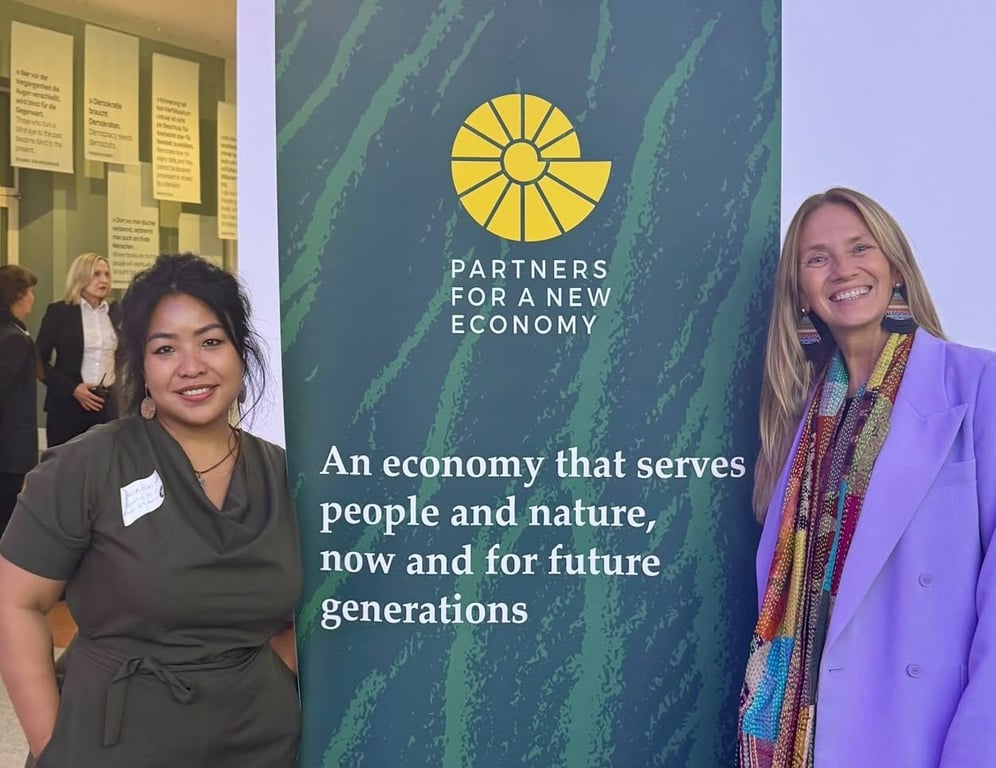
Photo: Trimita and Eszter (left to right) at the 2026 New Economies Gathering in Bonn