May 26, 2026
Dear readers,
The past month has seen a flurry of events examining future pathways for development and while trust, accountability and inclusion get mentioned regularly, it is not always with consistent meaning or emphasis. Reflecting on last week’s Global Partnership Conference in London, Anuradha Joshi highlights the need to embed accountability in digital systems and makes a welcome call for investing in democracy and rule of law, while Nathaniel Heller and Kristin Lord offer thoughtful prescriptions for philanthropy that include an urging to “Invest directly in governments while rediscovering the importance of good governance".
Such calls were less apparent in a parallel discussion in Washington on the future of U.S. foreign assistance, although the need to adjust for lost human rights funding is clear. That’s a message resonant with last months’ Ottawa Civic Space Summit - you can now see the Summit summary and photos.
Lots of stories this week from credit worthiness to sand mining to accountable journalism to all the latest jobs and events.
Happy reading!
TAI team
What's New
Louise Crow lays out five things to focus on for an effective evaluation ecosystem around government AI systems that can support much-needed transparency and democratic oversight.
Accountability Lab Pakistan has released its latest Country Analysis Report, examining how the country is navigating growing geopolitical, economic and governance pressures. The team explore political polarisation, institutional trust, economic stability and climate vulnerability, and what they mean for governance and public accountability in a rapidly changing global landscape.
Judith Mwai adds her voice to those calling for the creation of an African Credit Rating Agency, arguing that major global ratings firms systematically undervalue African economies and drive up borrowing costs across the continent. In TRT Afrika, she highlights how current ratings models focus heavily on financial risk while overlooking the long-term gains generated by infrastructure and development investments.
Cambodian authorities have dismantled three illegal gold mining sites inside Veun Sai-Siem Pang National Park as part of a multi-agency crackdown aimed at protecting natural resources and preventing environmental damage. The operation also highlights growing efforts to tackle illegal extraction activities linked to lost public revenue and ecosystem degradation.
As civic space continues to shrink across East and Southeast Asia, civil society groups are facing growing pressure alongside some of the toughest funding conditions in years. A recent convening in Jakarta brought together 25 representatives from 10 countries to discuss shared strategies for defending digital democracy under an initiative led by Tifa Foundation and CIVICUS.
Ana Good God and Staffan Lindberg outline six key trends shaping the global political landscape. To reverse democratic decline, they suggest governments will need to address underlying grievances such as economic inequality, climate change, migration and geopolitical instability, while also improving governance and policy responsiveness.
Excessive sand extraction is threatening ecosystems and livelihoods worldwide. United Nations Environment Programme warns that the industry already removes enough sand each year to build more than 19,000 Great Pyramids of Giza, and explores how governments could respond to the growing environmental and development pressures linked to rising global demand.
British Deputy Prime Minister David Lammy called illicit finance and corruption “one of the great progressive causes of our times,” warning that trillions of dollars are being diverted away from public services and into the hands of kleptocrats and their networks. Speaking at the Global Partnerships Conference, he urged governments to move beyond transparency alone and take stronger action against financial impunity and exploitation. However, the U.K. government has delayed its planned Illicit Finance Summit until end of the year.
ICYMI: Open Ownership has released a new policy brief guiding governments on how to design access to beneficial ownership information. The publication explores who should be able to access the data, how it can be made more usable and transparent, and what safeguards are needed to balance public interest with privacy protections.
For those tracking the state of multilateral governance, there is a welcome sign of cooperation at the United Nations where member states adopted the landmark International Court of Justice climate resolution with 141 votes in favour. What began as an initiative led by Pacific youth activists and frontline states has evolved into a global legal and political process that could reshape climate accountability under international law.
How can journalists and media organisations hold power to account amid growing political pressure, digital disruption and declining trust in media institutions? News Fix explores a new rights-based framework for journalism aimed at rethinking this role while strengthening accountability and public interest reporting.
ESSENTIAL READING
Jonathan Rausch looks at the latest efforts to secure supplies of critical minerals and worries about the role of illicit actors. He argues that it remains “important that the United States demonstrate that it can compete vigorously for critical minerals access without derogating the rule of law.”
From Our Members
OPEN SOCIETY FOUNDATION: Has launched a new $300 million initiative aimed at advancing economic security and defending civil liberties in the United States. The multi-year effort comes amid growing concerns over democratic backsliding, inequality and attacks on civic freedoms across the country.
MACARTHUR FOUNDATION: President John Palfrey reflects on the role philanthropy can play in moments of deep uncertainty, arguing that charitable giving is not only a tool for social change but also a way to sustain hope and democratic values. Speaking at the Milken Institute Global Conference, Palfrey joined other sector leaders to discuss how philanthropy is evolving to respond to growing social, political, and economic pressures.
ESSENTIAL LISTENING:
What exactly is private equity, and why is it increasingly shaping everything from care homes to public infrastructure? In the latest episode of The Taxcast, journalists and tax justice experts unpack how private equity firms are reshaping the global economy and what governments could do to better regulate the industry.
TOOLS AND TRENDS FOR FUNDERS
Jessyca Dudley, Yvonne Moore and Radhika Nayar argue in Nonprofit Quarterly that US philanthropy remains shaped by “WEIRD” assumptions (Western, educated, industrialized, rich and democratic) that can limit more equitable approaches to funding. Drawing from Global Majority practices, the authors highlight alternative models centred on trust, reciprocity and community accountability.
Early results from a global survey launched by Swedwatch, the Business & Human Rights Resource Centre and the European Coalition for Corporate Justice reveal deep funding cuts across the business and human rights field, with organisations reporting an average budget reduction of 43% between 2024 and 2026. The survey also points to sharper impacts in the Global South and among network organisations.
Useful for funders with place-based programming, this new guide from Learning for Sustainability explores how indicators can be developed and used in collaborative, multi-actor settings. Drawing on systems thinking and evaluation practice, the guide outlines approaches to support shared learning, reflection and decision-making across complex local contexts.
Mike Suctari reviews the new transparency reporting initiative of the U.S. Internal Revenue Service affecting nonprofits and fiscal sponsors operating in the U.S. Among the concerns raised by critics is that the proposal could allow increased monitoring or targeting of civil society organisations working on contentious social or political issues.
ESSENTIAL LISTENING:
In this podcast, Eszter Filippinyi (TAI) and Vanja Skoric (ECNL) bring together civil society leaders from Ukraine, Serbia, Kenya, Brazil, and the global human rights field to reflect on what resilience really means in times of crisis. The conversation moves beyond simple ideas of “bouncing back” and instead presents resilience as something collective, contextual, and deeply connected to care, trust, and shared purpose.
Focused Topic of the Week
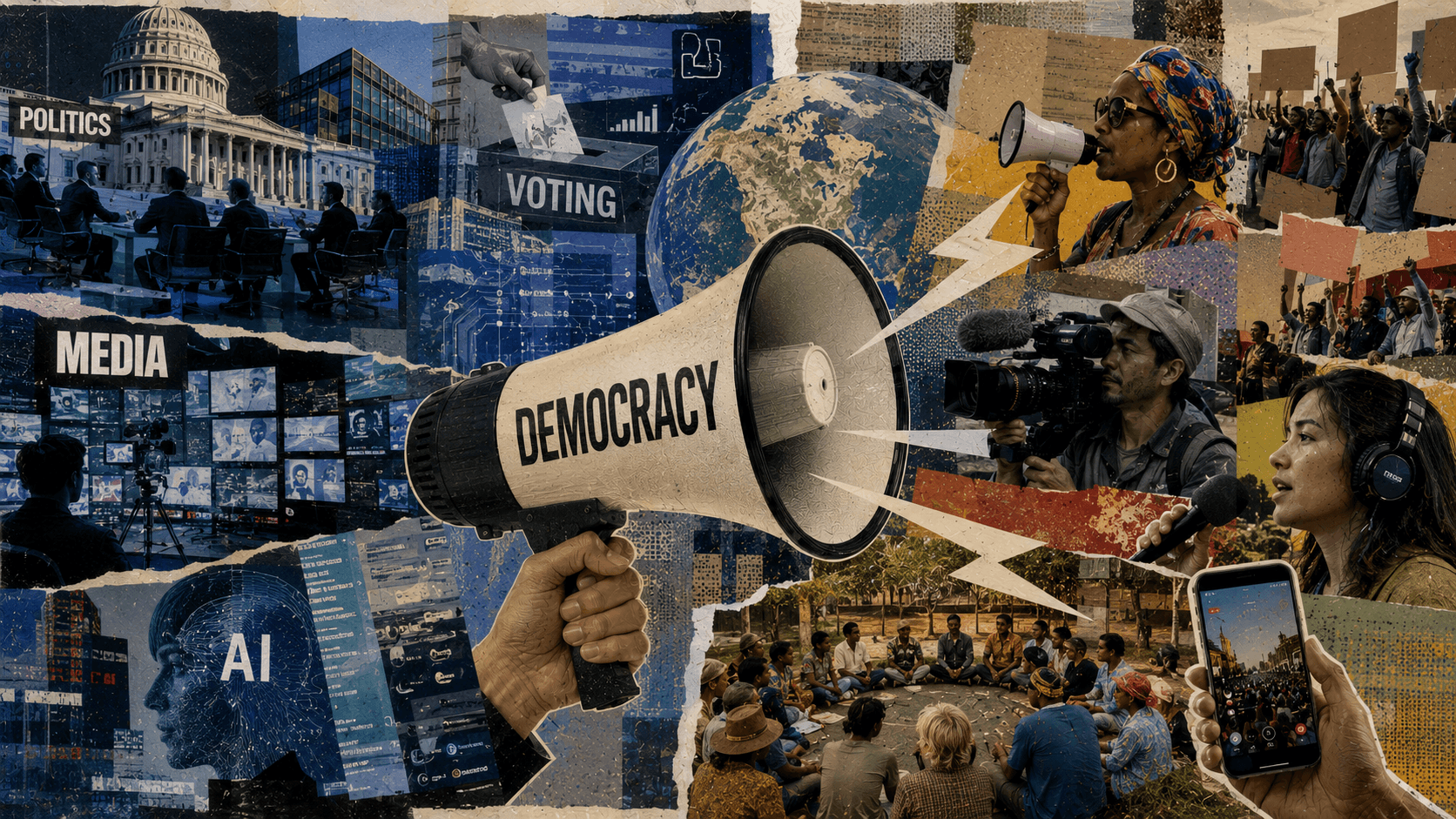
Who Shapes Democracy? Narratives, Power and Participation
Too often, democracy is framed narrowly around voting and institutions, while citizens demand something deeper: meaningful participation in the decisions that shape their lives. Increasingly, researchers and civil society actors are asking not only how democracy is defended, but also who gets to define what democracy means in the first place.
Omar H. Mohammed from Global Hive argues that democratic health ties to narrative power: who creates stories, whose voices are legitimised, and whose experiences remain marginalised. Using the concept of “narrative sovereignty,” the article champions the ability of communities — particularly from the “Global Majority” — to define themselves on their own terms rather than through narratives imposed by institutions, media systems or funders from the Global North. Fenya Fischler highlights barriers to achieving this sovereignty, including the concentration of funding and legitimacy in the Global North and the growing influence of AI-driven platforms in shaping public discourse.
Many innovative practices that resist dominant democratic narratives remain largely unheard. This invisibility becomes a problem in itself, especially when communities from the “Global Majority” are already experimenting with new forms of participation and storytelling. IRIS Collaborative asked ten organisations around the world how they are adapting to AI-driven platforms. The report found that activists, journalists and community storytellers are co-opting technology and culture, countering surveillance and disinformation, and experimenting with new forms of storytelling and organising to challenge authoritarianism and expand democratic participation. In this sense, technology becomes not only a tool of control, but also a terrain of narrative struggle where non-hegemonic voices fight for visibility and legitimacy.
Practical tools are also emerging to rethink how democracy is framed publicly. A recent toolkit developed by the FrameWorks Institute’s Culture Change Project in collaboration with the Democracy Revival Center encourages movements to move beyond fear-based narratives and instead communicate democracy through shared futures, collective agency and belonging. Read alongside TAI’s own The Stories We Tell describing how funders and civil society actors can support narratives that build legitimacy, belonging and collective agency rather than simply reacting to crises. Through ongoing conversations — including collaborations with the Democracy Narratives Alliance — TAI aims to create space for practitioners and funders to reflect on how democratic narratives are shaped, challenged and sustained.
JOBS
Multiple openings - Hewlett Foundation
Multiple openings - MacArthur Foundation
Multiple Openings - Gates Foundation
Multiple Openings - Social Action, Development Cooperation, Culture, Disability, and Health Sectors in Spain
Multiple Openings - UNCAC Coalition
Multiple Openings- Equality Now Jobs
Internships - International Accountability Project
Director of Global Affairs - Sequoia Climate Foundation
Director, Strategic Communications Network – Global Fund for a New Economy (GFNE).
Policy Advisor for Natural Resource Justice - Oxfam America
Senior Director, Critical Minerals and Community Positive Energy Transition, World Wildlife Fund
Senior Program Officer- Democracy Fund
Associate Director, Global Energy Transition Initiative - ClimateWorks Foundation
Senior Manager for Programs and Delivery - Civic Strength Partners (1 year fixed term contract).
Chief Executive Officer - Global Witness. Deadline: May 29, 2026.
Director Environment Programme (Geneva)- Oak Foundation
CALLS
People Powered is accepting applications for two global programmes offering funding and mentorship to democracy changemakers working to strengthen participation and civic engagement worldwide.
Re-D Fund is now accepting applications for Cohort 2 of the Reimagining Futures for Digital Democracy fund. The initiative supports civil society organisations, collectives and networks working to strengthen digital democracy, civic space and organisational resilience across East and Southeast Asia. Deadline: 5 June 2026.
The American University Washington College of Law is accepting applications for its 2026 Summer Anti-Corruption Law Certificate Program (June 1–4 and 8–11, in person and remote). Four courses are on offer, covering bribery law and compliance, cryptocurrency and illicit finance, anti-corruption legal frameworks, and AI, with discounted rates for NGO, academic, and government participants, and limited tuition assistance available.
The European Endowment for Democracy provides rolling funding for local democracy organizations in the Eastern Partnership, Middle East and North Africa, and Western Balkans & Turkey.
The Fifth Element invites blog contributions on systems transformation from practitioners and researchers, drawing on both lived experience and analysis across diverse perspectives.
The UK government has opened a Call for Evidence for its next National Action Plan on Open Government, offering a key opportunity for civil society input. The UK Open Government Civil Society Network has published a submission guide. Deadline: May 25, 2026.
The National Endowment for Democracy offers grants to advance democratic goals and strengthen democratic institutions. Deadline: June 6, 2026.
The Political Economy Analysis in Action online training course runs from September to December 2026. Register before June 13 to benefit from the early bird discount.
Thousand Currents will host its first Academy in the Global South this August in Brazil, focused on internationalism and global solidarity, including immersive engagement with social movements shaping transformative change. August 2-7, 2026 | São Paulo, Brazil.
CALENDAR
Second session of UNDP's webinar series Civic Engagement in the Digital Age, co-organized with Democracy X. May 26, 8:00–9:30 PM EST.
Shifting the Landscape: Increasing Women’s Political Representation and Fostering Male Champions - A Zambia Case Study (Webinar) on May 27, 2026
10th Global Solutions Summit 2026, Berlin. June 1-2, 2026.
Oslo Freedom Forum, Oslo, Norway. June 1-3, 2026.
People Powered webinar on Climate Democracy in Action on June 2, 2026
Addis Tax Initiative webinar, “Making green tax incentives work: protecting revenue while accelerating the energy transition.” June 2, 2026, 13:00–14:30 CEST.
First European Forum on Environmental Human Rights Defenders. Strasbourg, France, June 3–4, 2026.
Dialogue on Climate Philanthropy and South-South Collaboration convened by The Arab Foundations Forum. Online, June 3, 2026
Rogue Union Foresight Retreat for philanthropy leaders. June 7-11.
Asia Clean Energy Forum. Manila, Philippines, June 8–11, 2026.
Designing Democratic Resilience, EPD Annual Conference 2026. Brussels, June 9, 2026.
GDC Asia Forum 2026, Global Democracy Coalition. June 11, 2026 | Seoul, South Korea.
Introducing Tulsi Platform: A women-led global platform rooted in Global South knowledge and practices while navigating Northern systems and structures. June 24th, 2026 - 8:00 AM Mexico City / 10:00 AM NYC / London 3:00 PM
IAFFE Annual Conference. June 25–26, 2026 (online) | July 9–11, 2026 (in person) | Cali, Colombia.
WINGSForum 2026 in Montreal under the theme "ACT – Activate, Collaborate, Transcend." Save the date, more details to follow in early 2026. September 28-30, 2026.
Better Politics Foundation Flagship Gathering - Brussels, November 18–20, 2026.
International Anti-Corruption Conference (IACC) in Punta Cana, Dominican Republic. December 1-4, 2026.
We’d love to hear from you on how we can further improve TAI Weekly to better serve your needs in program management on the transparency, accountability, improved grantmaking and civic space. Please direct your feedback to [email protected] or SUBSCRIBE TO TAI WEEKLY