Foundations are almost constantly in the middle of a strategic review. The end result might be a program pause, a portfolio shift, or a complete exit from an entire sector or region. For civil society organizations, however, the reality of that decision usually only becomes visible once it is already final.
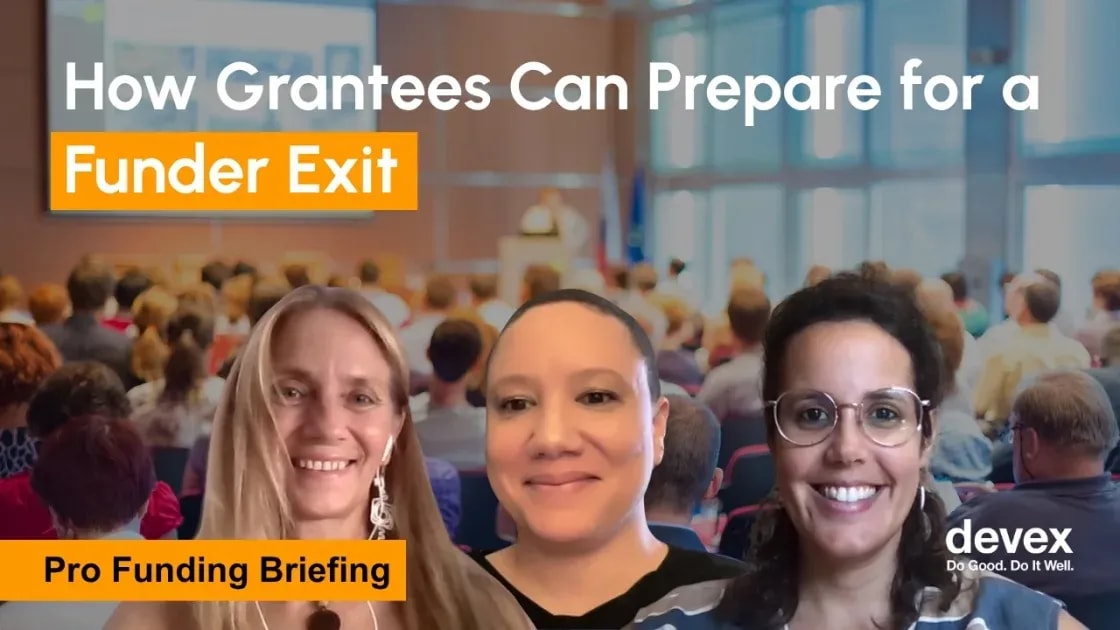
A recent Devex Pro Funding briefing brought together Eszter Filippinyi, Deputy Director at the TAI Collaborative, and Cheri-Leigh Erasmus, Co-founder of Civic Strength Partners and Co-CEO of Accountability Lab. Together, they looked at funder exits from the grantee’s side: examining why communication breaks down, what organizations should concretely request when a donor leaves, and what responsible funders should offer without being asked.
1. That Silence from Your Program Officer? It’s Structural, Not Personal
When funding renewal is in doubt, grantees often try to "read the runes" to figure out what is coming. Yet the silence or evasiveness from a program officer is rarely intentional.
As Erasmus explained, the people delivering the news are often the last inside a foundation to know what is actually happening. A program officer may sense internal restructuring bubbling up, but they might not sit on the decision-making committees. They want to protect the relationship, but they genuinely lack answers.
For Filippinyi, fixing this dynamic sits squarely with foundation leadership: clearer communication with civil society partners requires clearer, earlier internal communication within grantmaking institutions so frontline staff are never kept in the dark.
2. Don’t Just Signal Distress—Bring a Specific Number and Concrete Asks
When exit conversations happen, general distress without a plan rarely yields results. Grantees fare far better when they arrive with well-reasoned, concrete requests.
If the opportunity for a tie-off or bridge grant arises, organizations need to state exact figures: "We need $300,000 because it will maintain key relationships and allow us to accomplish X, Y, and Z."
Beyond direct bridge capital, high-impact asks include:
Strategic Packaging: Practical support evaluating and reframing the organization’s body of work so it speaks directly to other donor priorities.
Joint Visibility: Co-publishing a final report summarizing program achievements alongside the departing funder, which immediately lends institutional gravitas when approaching new donors.
Warm Introductions: Far from being purely ceremonial, warm introductions signal that a funder has already conducted rigorous due diligence, saving incoming program officers substantial vetting time.
Transition Support: Foundations can fund third-party legal, consulting, and operational assistance—an area where Civic Strength Partners is currently working with donors to cover closeout and restructuring costs for transitioning groups.
Funders should not wait for grantees to ask for these measures; they should proactively offer clear timelines, bridge funding, and introductions as standard practice.
3. The Overlooked Asset: Space to Convene and Test New Ideas
Funding matters, but Filippinyi pointed out that the second most requested resource during transitions is often neglected: space to convene, make sense of the moment, and test new ideas with permission to fail.
Drawing on her experience during major restructuring at the Open Society Foundations, Filippinyi noted that meaningful accompaniment goes beyond dollars. It involves helping partners reframe what they have built for new audiences, facilitating peer connections, and providing rooms for candid sensemaking.
Crucially, this is an asset funders can offer even when their own grant portfolios are actively contracting.
4. Coordinate Exits to Prevent "Extinction Events"
Funder departures carry systemic ripple effects. When several long-standing donors in anti-corruption and illicit financial flows pulled back simultaneously, the field was gutted at the exact moment it was needed most.
As Filippinyi emphasized, departing funders have a responsibility to coordinate with peers to ensure they do not unintentionally destroy entire ecosystems of organizations by exiting en masse.
5. Plan for Wind-Downs and Map the True Cost of Closing
Both speakers urged organizations not to wait for an exit to start preparing. Groups that routinely assess risk, map scenarios, and operate in collaborative networks survive far better than isolated actors.
Planning also means facing the possibility that replacement funding might not arrive. Knowing what a responsible wind-down costs—including staff settlements, contract terminations, and administrative closeout obligations—gives an organization a clear number to take to a departing funder.
Building What Comes Next
With global funding for civil society shrinking, competition between organizations is mounting. While new actors—such as high-net-worth individuals and corporate foundations—are stepping into philanthropy, they cannot fill every gap.
Looking ahead, sustainable resilience will require more independent funding architecture, such as permanent endowments, paired with funder advocacy to secure the legal and political frameworks that make domestic resource mobilization possible. Until then, how funders leave a field will remain the ultimate measure of their commitment to trust and partnership.
This piece is part of our two-part series on the shifting realities of global philanthropy, exploring what it takes to navigate funder exits responsibly and leave local ecosystems resilient. See our first post exploring long-term exit planning through the MacArthur Foundation's experience