April 7, 2026
Dear readers,
TAI is excited for a convening in Buenos Aires this week on the future of civil society and there are some relevant readings this week, starting with “New Approaches to Defending Global Civil Society”, edited by Richard Youngs and Elene Panchulidze. They offer some original ideas for ensuring that independent civil society is not pushed off the stage of global politics.
Plus, we round up some anti-corruption stories and the latest from the world of international tax, where injustices extend to this summer’s World Cup. And don’t forget all the usual funder news, jobs and events.
Happy reading!
TAI team
What's New
Two new guides from the National Democratic Institute help nonpartisan election observers monitor digital threats. “Digital Democracy or Data Exploitation” explores how data-driven and AI-powered campaigns use personal data, offering practical tools and frameworks for integrating data protection into observation. “Synthetic Voices, Real Voters” helps observers assess generative AI, including synthetic content, AI-driven tactics, and chatbot use by voters.
The New South Institute has released a new working paper, “South Africa's Third Transition”, by NSI Co-Founder and Director Ivor Chipkin, examining a quiet but potentially far-reaching shift in South Africa's governance landscape.
A new guide from Liberties, “Messaging that (Re)builds Public Support for Civic Space”, sets out what messaging helps grow support for NGOs working on human rights-related issues, including environmental protection and migration.
Issa Souare argues that Africa’s critical mineral boom needs better democratic guardrails. He fears “familiar dangers: concentrated rents, opaque contracting, weakened local consent, and executive decisionmaking that outruns public scrutiny.”
An investigation by Arab Reporters for Investigative Journalism reveals how female journalists in Egypt face online threats that force many to reduce their presence at work or leave journalism altogether, in the absence of protection policies from either their media organizations or the Egyptian Journalists' Syndicate.
The International Institute for Sustainable Development warns that surging investor-state tax arbitration cases erode nations' revenue control, and calls attention to prospective UN Tax Convention reforms as a bulwark.
A brief prepared in collaboration with members and partners of the Coalition for Human Rights in Development, documents two regulatory trends in Latin America that seriously restrict civic space in the context of development projects.
Lucovic Bernad from the International Centre for Tax and Development explores pathways to unlocking inclusive digital payments and tax compliance in Africa, drawing on discussions from MWC Kigali.
A report on the Reimagining the Civic Commons initiative, which brought together funders including Knight Foundation and the Kresge Foundation, shares lessons from community-led investments in public spaces in Ohio in the United States and their role in promoting civic engagement.
A new op-ed in The Guardian by Bernie Sanders makes the case for a billionaire wealth tax, arguing that the wealthiest must start paying their fair share.
A storytelling series from three Keseb Fellows, Jeanine Abrams McLean, Áurea Carolina, and Tessa Dooms, explores the possibilities and costs of transitioning from civil society into public office for women leaders. You can also read TAI's 2026 report “Changing the Rules of the Game: A Funders' Guide to Advancing Women's Substantive Political Participation”.
The Buenos Aires Herald reflects on how the Memoria, Verdad y Justicia memorial, which began as a demand directed at power, has slowly become a tradition, and a narrative through which democracy tells the story of its own origins.
From Our Members
HUMANITY UNITED: In this guest blog, Pedro Portela reflects on key governance lessons from his work with HU and its partners, drawing on case studies explored in the full piece. While the organization is committed to amplifying diverse expertise and lived experience, the views expressed are those of the author.
OPEN SOCIETY FOUNDATIONS: Shares a piece making the case for protecting human rights defenders in the Sahel region of West Africa.
FORD FOUNDATION: President Heather Gerken shared reflections on the foundation’s work with partners in Mexico and Central America advancing climate justice, protecting biodiversity in tropical forests, and pushing for a just energy transition. She emphasized that the most effective efforts are led by communities closest to the land and most affected by its changes.
TOOLS AND TRENDS FOR FUNDERS
A piece in Alliance Magazine, “The Broken Contract” by György Hámori, Arun Kumar, and Araddhya Mehtta, argues that the contract between civil society, the state, and philanthropy is broken, urging funders to confront inequality, share power with communities, and move from short-term projects to long-term support for systemic change.
A mapping by Triple-Minds identifies 50 funds that are shifting power to frontline communities. What they share: a commitment to general operating support, recognition that community members, not outside consultants, are the experts, and a willingness to absorb the risk of vetting local groups in order to build bridges for larger donors.
Transformative Donor Organizing, a new guide by Isaac Lev Szmonko from Solidaire Network, offers a roadmap for building political homes where wealthy people become lifelong movement allies, redistributing the majority of their wealth and organizing others to do the same.
A recent Devex piece by Jessica Abrahams reflects on the rise of collaborative philanthropy, where funders pool resources to increase impact. Although not new, this approach is expanding rapidly: a recent Bridgespan survey of over 300 funding collaboratives found that about half were founded in the past decade, reflecting a shift toward more strategic, collective giving.
ESSENTIAL READING:
Jeremy Nicholls new book, “The Accounting Paradox”, examines how financial accounting standards, rather than science or public policy, shape how profit is defined and influence investment decisions and business behavior worldwide, while arguing that these same systems could be reoriented to help repair the damage they have caused.
Focused Topic of the Week
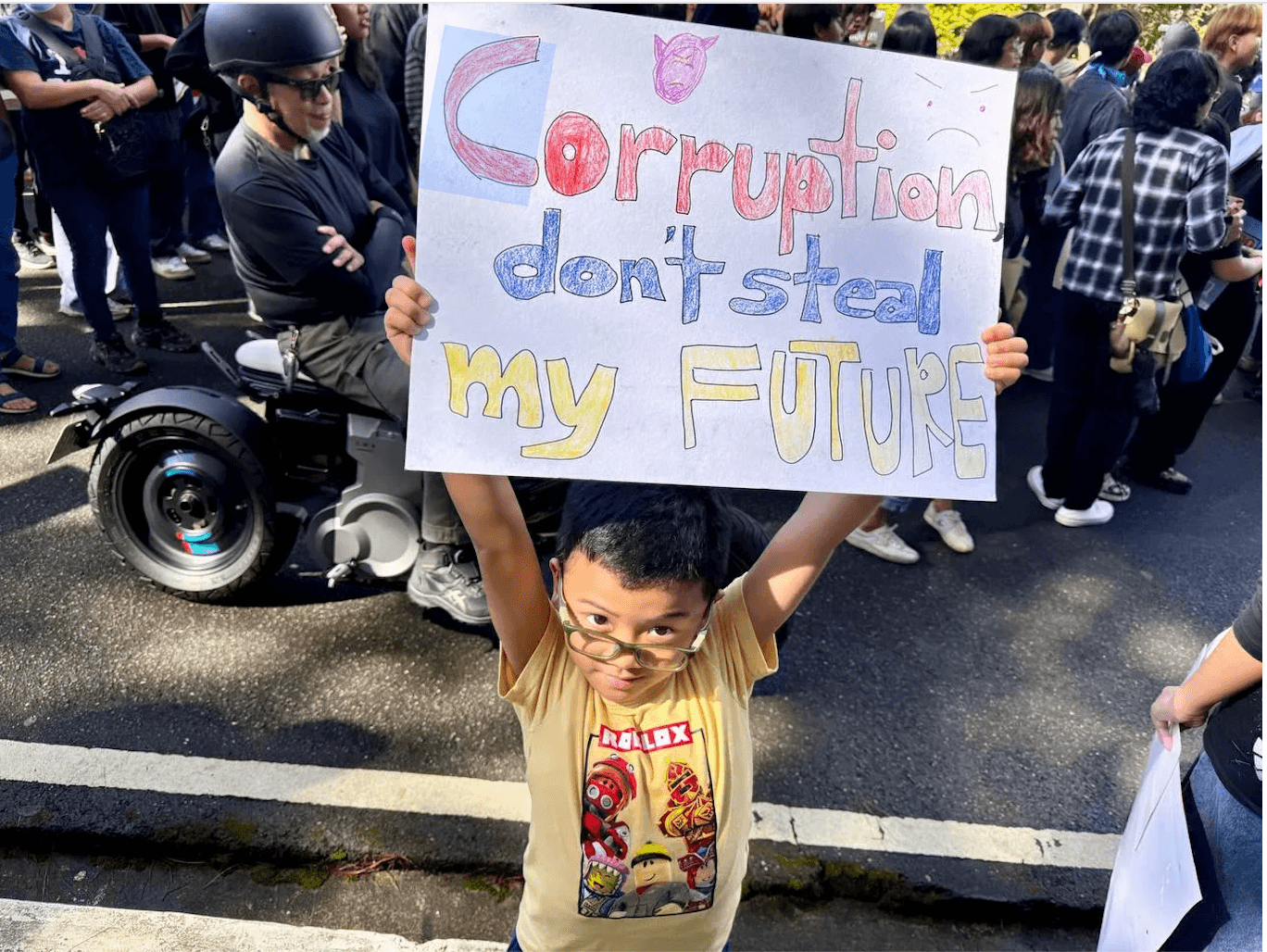
Corruption's Fury Unleashed: Protests, Probes, and Paths to Accountability
Public outrage over corruption continues to ignite protests, topple leaders, and sway elections worldwide, even as entrenched systems resist change, according to a new Carnegie Endowment analysis. Building on Panama Papers fallout, it showcases how this dynamic persists, but notes a U.S. policy shift under the Trump administration away from global anti-corruption alignment.
President Trump is trying to draw attention to alleged fraud in healthcare provision in the U.S., but there is no doubt as to the costs of corruption in the sector in different contexts. Alan Hudson synthesizes 40 research papers from the Accountability in Corruption and Education project, detailing corruption's toll in Bangladesh, Nigeria, Tanzania, Uganda, and beyond, and unpacks reform incentives and political economies that perpetuate graft.
Journalists are mapping what’s happening in the shadows. Across 11 countries, a Pulitzer Center-backed probe used public records, interviews, aerial surveys, satellite imagery, and security protocols to expose illicit economies ravaging the Amazon, showing data-driven scrutiny can illuminate hidden corruption networks.
Turning to prevention, the CoST- the Infrastructure Transparency Initiative has rolled out a new methodology with the Government Transparency Institute, that enables governments to quantify financial savings from transparency, accountability, and public participation in infrastructure projects (a sector prone to corruption).
JOBS
Multiple openings - Hewlett Foundation
Multiple openings - MacArthur Foundation
Multiple Openings - Hilton Foundation
Multiple Openings - Gates Foundation
Multiple Openings - Transparency International
Multiple Openings - Social Action, Development Cooperation, Culture, Disability, and Health Sectors in Spain
Multiple Openings - National Endowment for Democracy (NED)
Multiple Openings - UNCAC Coalition
Director of Global Affairs - Sequoia Climate Foundation
Director, Strategic Communications Network – Global Fund for a New Economy (GFNE).
Director of Finance and Operations - Climate Justice Resilience Fund (CJRF).Deadline: April 13, 2026.
CALLS
The Wellbeing Project, in research partnership with the Center for Healthy Minds and Humin, is leading the State of Changemaker Wellbeing Survey and inviting organizations and networks to express interest in sharing it with their staff, members, or wider community. Survey period: April 13 – May 22.
EDGE Funders' Global Engagement Lab is a 9-month program for progressive funders seeking systemic change and personal growth, with cohort learning and in-person retreats. Applications open March 2026; costs USD 4,000–7,000, with discounts for EDGE members.
OTF's Internet Freedom Fund offers project-based funding for internet freedom, privacy, and secure access, open to all regions. Rolling deadline.
The American University Washington College of Law is accepting applications for its 2026 Summer Anti-Corruption Law Certificate Program (June 1–4 and 8–11, in person and remote). Four courses are on offer, covering bribery law and compliance, cryptocurrency and illicit finance, anti-corruption legal frameworks, and AI, with discounted rates for NGO, academic, and government participants, and limited tuition assistance available.
The European Endowment for Democracy provides rolling funding for local democracy organizations in the Eastern Partnership, Middle East and North Africa, and Western Balkans & Turkey.
Support for independent media in Kenya – Media Development Investment Fund. Capacity building programme. Rolling deadline.
The IJ4EU Investigation Support Scheme offers project-based grants for cross-border investigations of public interest in Europe. Deadline: April 13.
WINGSForum 2026 is calling for member-led session proposals. Submit your ideas, experiments, and lessons learned for a wider stage. Deadline: April 23, 2026.
The Climate Justice Resilience Fund is seeking three new members to join its Governing Board. Deadline: May 13, 2026.
The National Endowment for Democracy offers grants to advance democratic goals and strengthen democratic institutions. Deadline: June 6, 2026.
Thousand Currents will host its first Academy in the Global South this August in Brazil, focused on internationalism and global solidarity, including immersive engagement with social movements shaping transformative change. August 2-7, 2026 | São Paulo, Brazil.
CALENDAR
The role of ODA in strengthening the capacity of Accountability Stakeholders for Domestic Revenue Mobilisation. April 8, 2026.
The Pacific Philanthropy Gap: What's holding donors back and how we move forward. April 8, 2026.
Strengthening mining taxation for sustainable development: Peer learning across ATI partner countries. April 15, 2026.
Who Shapes the Story? Exploring Narrative Change in Practice. April 15, 2026 | 14:00–15:30 CEST.
Rewriting the Case for Aid: Purpose, Priorities and Political Realities. Wednesday, April 15, 2026, 11:00 AM–12:15 PM EDT.
8th meeting of the Community of Practice on Tax Expenditures. April 16, 2026.
Who's Really in Charge? Tackling State Capture in the Age of Democratic Backsliding. Thursday, April 16, 2026, 9:00 AM EDT / 3:00 PM CEST.
Igniting Hope: The Inaugural Ottawa Civic Space Summit. Registration closes April 10, 2026. Event from April 21-23, 2026.
Ottawa Civic Space Summit. Registration closes April 10, 2026. April 21–23.
Fourth meeting of the Conference of the Parties to the Escazú Agreement. Nassau, Bahamas, April 21–24, 2026.
Mythbusting AI Narratives and Reclaiming Agency with Zara Rahman, Leap of Leadership Workshop. April 22, 2026 | 13:00 UTC.
Intergenerational Conversation Series, recurring sessions on meaningful youth engagement in philanthropy. April 22 – June 3, 2026.
GDC Americas Forum 2026, Global Democracy Coalition. April 23–24, 2026 | Asunción, Paraguay.
First Conference on Transitioning Away from Fossil Fuels, hosted by Colombia and the Netherlands. Santa Marta, Colombia, April 24–29, 2026.
Othering & Belonging Conference, Louisville, Kentucky, March 31-April 1, 2026.
UNESCO World Press Freedom Day 2026, Lusaka, Zambia. May 4-5.
RightsCon 2026, Lusaka, Zambia. May 5-8.
GDC Europe Forum 2026, Global Democracy Coalition. May 19, 2026 | Prague, Czech Republic.
Rabat, Morocco: On Think Tanks Conference, focusing on "Think Tanks and Trust." 19–21 May 2026.
10th Global Solutions Summit 2026, Berlin. June 1-2, 2026.
Oslo Freedom Forum, Oslo, Norway. June 1-3, 2026.
First European Forum on Environmental Human Rights Defenders. Strasbourg, France, June 3–4, 2026.
Asia Clean Energy Forum. Manila, Philippines, June 8–11, 2026.
Designing Democratic Resilience, EPD Annual Conference 2026. Brussels, June 9, 2026.
GDC Asia Forum 2026, Global Democracy Coalition. June 11, 2026 | Seoul, South Korea.
IAFFE Annual Conference. June 25–26, 2026 (online) | July 9–11, 2026 (in person) | Cali, Colombia.
WINGSForum 2026 in Montreal under the theme "ACT – Activate, Collaborate, Transcend." Save the date, more details to follow in early 2026. September 28-30, 2026.
International Anti-Corruption Conference (IACC) in Punta Cana, Dominican Republic. December 1-4, 2026.
We’d love to hear from you on how we can further improve TAI Weekly to better serve your needs in program management on the transparency, accountability, improved grantmaking and civic space. Please direct your feedback to [email protected] or