January 12, 2026
Dear readers,
The TAI Weekly is back refreshed for a new year, although the world did not want to give us much respite judging by the news cycle!
We have a packed issue to kick off 2026, but start by noting the US decision to withdraw from over sixty global organizations, including those with a democracy, rights or accountability aspect. It has also successfully pushed fellow OECD members to give its companies an exception from the global minimum tax agreement - a step much criticized in the tax justice community. It signals a step away from global governance that is in stark contrast to China’s positioning and Xi Jinping’s new Global Governance Initiative - one channel to build influence. This year will reveal how much the global community can move forward despite Washington’s wishes. Daron Acemoglu is quick to argue that to rebuild rules-based international relations, we will need a new philosophical foundation.
Happy reading!
TAI team
What's New
Version 7 of the Democratic Erosion Event Dataset (DEED) is now available. Covering 23,421 events across 156 countries from 2000 to 2023, DEED v7 tracks democratic erosion, autocratic consolidation, resistance, and destabilizing dynamics.
Fellow funder network Philanthropy for Active Civic Engagement shares compelling insights from their Democracy Futures Project on the evolving landscape of democracy support and civic engagement.
New research in the journal International Organization challenges common assumptions about corporate accountability. The study suggests investors respond more to the risk of punishment for overseas bribery than to the corrupt behavior itself, raising questions about how effective current enforcement mechanisms really are.
International Budget Partnership has published a guide to addressing public procurement risks, breaking down the process into nine clear phases to identify where things commonly go wrong, from poor planning and inappropriate procurement methods to weak contract oversight. The guide offers practical actions to reduce risks and improve service delivery.
As democracy support faces an uncertain future, Brandon Bohrn urges the European Union to sustain democracy and civic resilience as a core pillar of European engagement in neighboring regions, particularly EU candidate countries. His timely analysis comes ahead of an important meeting on the future of democracy support that TAI will join later this month.
Press freedom continues to face severe threats worldwide: nearly 70 media workers were killed in 2025, most at the hands of military groups and organized crime, while more than 500 journalists remain detained globally.
Opening Central Africa makes the case for beneficial ownership transparency in Africa, arguing it represents a strategic imperative for unlocking the continent's economic future and combating illicit financial flows.
Finance Uncovered exposes the complex financial networks surrounding José Mugrabi, the king of pop art, raising questions about illicit finance in the art world.
UBS estimates that billionaires will transfer approximately $6.9 trillion of wealth globally by 2040, with at least $5.9 trillion set to be passed to children. It is further fuel for debates about wealth concentration and engagement of a new generation of inherited wealth holders.
Charles Kenny analyzes the challenges inherent in using governance indicators as preconditions for donor support, examining shifts in the requirements of the Millennium Challenge Corporation and questioning whether such approaches truly advance development goals.
Looking ahead to the U.S. Chairmanship of the G20 this year, Mary Svenstrup identifies one potential bright spot: prospects for greater debt transparency, even amid concerns about broader international cohesion.
The OECD has released the second edition of Government at a Glance Southeast Asia. The 2025 edition offers comparable data on governance, with a focus on infrastructure investment, digital government and AI, fiscal sustainability, and public service delivery.
The Media Freedom Coalition has documented how member countries have stood up for media freedom in Georgia, which has served as a model for international solidarity in defending independent journalism.
While confidentiality clauses appear frequently in loan agreements, public debt transactions demand transparency. A new brief by Open Government Partnership, Transparency International, and the National Democratic Institute dismantles six common justifications for secrecy in sovereign lending and offers practical recommendations for creditors, borrowers, and the international community.
From Our Members
MACARTHUR FOUNDATION: Reflects on a decade of impact with their Big Bet on Nigeria, sharing lessons learned about planting seeds of accountability and supporting civil society resilience in one of Africa's most complex environments.
HUMANITY UNITED: Reflected on a year of progress, including the launch of its Racial Justice & Equity strategy, the publication of “Pathways to Peace”, global collaboration, and continued efforts to address forced labor, strengthen leadership, and align internally with its vision of a more just and peaceful world.
FORD FOUNDATION: Has shared a timely conversation on the ongoing challenges facing American democracy, featuring President Heather Gerken alongside former U.S. Court of Appeals Judge J. Michael Luttig and former U.S. Secretary of Homeland Security Jeh Johnson. The discussion underscored the shared responsibility of citizens to defend democratic norms and the rule of law.
ESSENTIAL READING
Alliance Magazine's guide to global philanthropy in 2026 offers predictions from philanthropy experts worldwide on the forces shaping the sector this year, emerging funding models, critical gaps, and trends readers should watch closely.
TOOLS AND TRENDS FOR FUNDERS
Claudia Yurley Quintero Rolón argues in Alliance Magazine that philanthropy cannot truly support grassroots actors from Global Majority contexts without addressing language barriers. Requiring advanced English proficiency continues to exclude community leaders from global knowledge spaces, raising questions about how inclusive philanthropy really is.
A United Nations report warns that philanthropists are increasingly avoiding involvement with "causes perceived as politically contentious, including human rights and diversity agendas." The report describes an existential threat to civil society, collective action, and human solidarity as major donors retreat from controversial but essential work.
The RINGO Project has published reflections from their latest community gathering on shifting accountability frameworks and the evolving relationship between funders and grantees.
Seema Jayachandran makes the case for counterfactual thinking in nonprofit fundraising, arguing that organizations and donors should more rigorously consider what would have happened without their interventions to better assess true impact.
ESSENTIAL READING:
The Financial Times investigative team examines why we should care about anonymous shell companies and other enablers of dark money. Their investigation into fraudster and spy Jan Marsalek demonstrates the extraordinary challenge of unraveling complex webs to trace where missing millions actually went, revealing the urgent need for beneficial ownership transparency.
Focused Topic of the Week
Democracy in the Age of the Authoritarian Stack
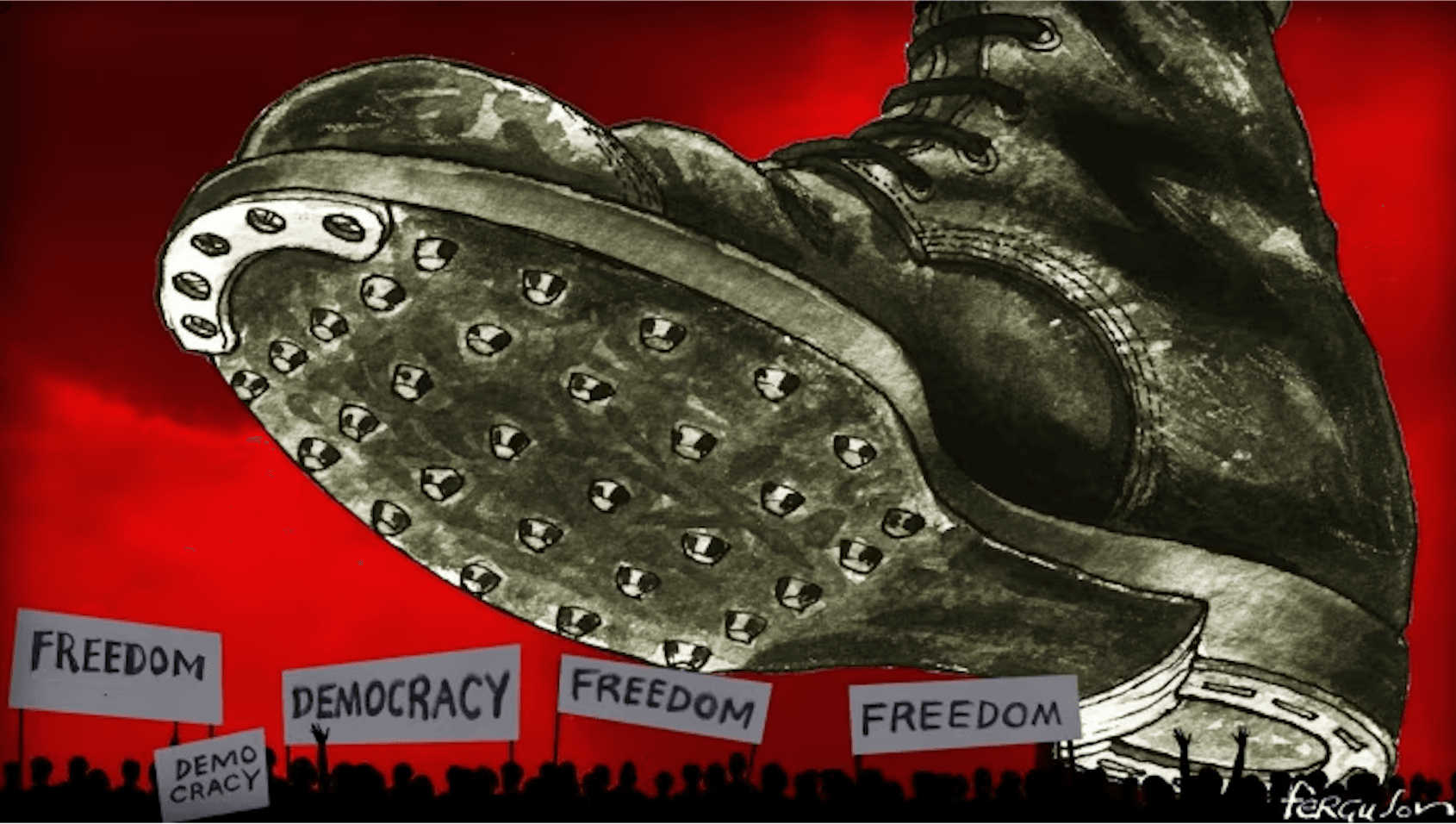
Is democracy being reorganized behind the scenes? Power now moves through corporate infrastructures, transnational alliances, and platform logics that were never designed to be accountable to the public. Elections still matter, but they increasingly sit atop systems that most voters cannot see, influence, or meaningfully challenge. Research suggests 2026 will pose a challenge not only to defend institutions, but to expose, contest, and re-politicize the machinery that now governs everyday political life.
Start with The Authoritarian Stack, a project to document how corporations, investment funds, and private actors have come to perform functions once reserved for the state. Cloud computing, artificial intelligence, defense technologies, financial infrastructure, drones, and satellite systems increasingly operate as the hidden operating system of governments. Decisions that shape public life are no longer made solely through accountable institutions, but through corporate boards and contractual arrangements that sit outside democratic oversight. The result, the project argues, is a form of post-democratic governance where authority persists, but responsibility is diffuse and accountability is weakened.
The spread of the “stack” is only reinforced by what Nic Cheeseman, Matías Bianchi, and Jennifer Cyr describe as the rise of “The Illiberal International”. Authoritarian and illiberal governments are no longer isolated or reactive. They cooperate, share tactics, and support one another across borders. This coordination reshapes the global order, making it harder for democratic norms to function as default standards. International institutions, trade relationships, and security arrangements increasingly accommodate regimes that hollow out democratic practices while maintaining formal structures.
Digital platforms play their own central role. Recent European Union data shows that radical populist parties consistently win disproportionate engagement on TikTok. Platform incentives reward emotionally charged, anti-elite, and divisive content, amplifying messages that erode trust in institutions and expertise. These outcomes are not necessarily driven by ideology, but by business models optimized for attention rather than democratic deliberation. Political influence is thus mediated by opaque algorithms that shape public debate without being subject to democratic scrutiny.
As these systems consolidate, the space for dissent narrows. Governments around the world are tightening controls on speech, increasing penalties for whistleblowers, and criminalizing acts of exposure that challenge entrenched power. In this context, civil disobedience and solidarity are not relics of an earlier democratic era but necessary responses to a political environment where formal channels of accountability are increasingly ineffective. The punishment of those who speak out is not incidental; it is a predictable outcome of governance structures designed to operate without transparency.
JOBS
Multiple openings - Hewlett Foundation
Multiple openings - MacArthur Foundation
Multiple Openings - Ford Foundation
Multiple Openings - Hilton Foundation
Multiple Openings - Gates Foundation
Multiple Openings - Transparency International
Multiple Openings - Social Action, Development Cooperation, Culture, Disability, and Health Sectors in Spain
Multiple Openings - Philanthropy Together
Multiple Openings - National Endowment for Democracy (NED)
Executive Director - FACT Coalition. Deadline: February 27, 2026.
CALLS
Two ScaleDem open calls are now live through 31 March 2026, offering eligible organizations across Europe and beyond funding, mentorship and peer learning to scale democratic innovations. The Piloting Programme supports bold new ideas with up to €100,000, and the Twinning Programme offers up to €65,500 for mentor–mentee communities adapting proven approaches.
Knight Center For Journalism: Free, on-demand online course on "A better way to cover civic life through listening" for journalists in all regions, offered by the Solutions Journalism Network.
Keseb’s Democracy Innovation Lab is backing early-stage ideas that reimagine the foundations of democracy. Its first iLab will support 10 community-building initiatives that strengthen inclusion and cross-group belonging. Nominate a Project Lead by January 16, 2026 (11:59 PM ET) or submit a pitch by February 2, 2026 (11:59 PM ET).
The call for workshop proposals for the 2026 International Anti-Corruption Conference (IACC) is now open. Under the theme "Igniting the Power of Integrity," the conference will take place in Punta Cana, Dominican Republic, from December 1-4, 2026. Professionals, civil society groups, activists, journalists, academics, and practitioners worldwide are invited to submit proposals by February 23, 2026.
The Extractive Industries Transparency Initiative is accepting proposals for partner sessions at its Global Conference set for June 24-25 in the Philippines. Deadline is January 30, 2026.
CALENDAR
The Risks That Crony Capitalism Poses to Our Democracy | January 20, 2026, 6:00 PM Paris time.
Reclaim the Economy Week. 26 January - 1 February 2026.
Not If, But How: Climate, Movements, and Transformative Change. January 27, February 3, 10, and 17, 2026.
People Powered 2026 Convening - A global gathering on participatory democracy. Nairobi, Kenya. March 2–5, 2026.
2026 Global Philanthropy Leadership Summit. March 18-20, 2026 | San Francisco, CA.
2026 OECD Global Anti-Corruption & Integrity Forum (GACIF). March 23-27, 2026 | Paris, France.
Igniting Hope: The Inaugural Ottawa Civic Space Summit. Registration closes April 10, 2026. Event from April 21-23, 2026.
Othering & Belonging Conference, Louisville, Kentucky, March 31-April 1, 2026.
Rabat, Morocco: On Think Tanks Conference, focusing on "Think Tanks and Trust." 19–21 May 2026.
WINGSForum 2026 in Montreal under the theme "ACT – Activate, Collaborate, Transcend." Save the date, more details to follow in early 2026. September 28-30, 2026.
International Anti-Corruption Conference (IACC) in Punta Cana, Dominican Republic. December 1-4, 2026.
We’d love to hear from you on how we can further improve TAI Weekly to better serve your needs in program management on the transparency, accountability, improved grantmaking and civic space. Please direct your feedback to [email protected] or